Jensen Huang Says GPT-6 Astra Was Trained on 100K Nvidia GPUs, 400K More Coming
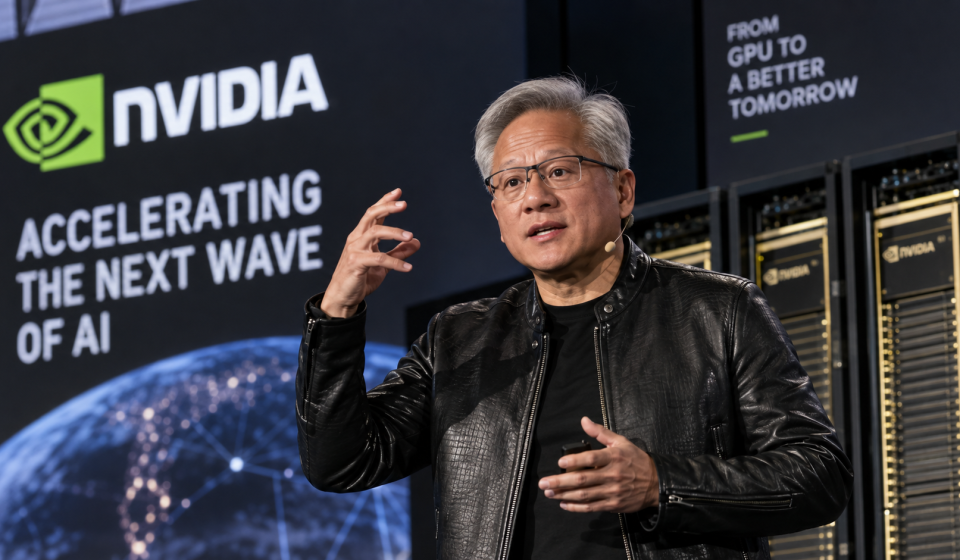
Nvidia CEO Jensen Huang has confirmed that OpenAI’s latest frontier model, GPT-6 Astra, was trained on more than 100,000 Nvidia Grace Blackwell NVLink72 systems, and that another 400,000 GPUs are already planned to come online next. The announcement, made via a post on X, represents one of the most significant disclosures about the scale of modern AI training infrastructure to date.
According to Huang, each NVLink72 system links 72 GPUs to function as a single unified computing unit, a design that represents a fundamental shift from Nvidia’s traditional approach of shipping processors eight to a board. The scale of this training run, the first OpenAI has conducted on more than 100,000 GPUs, underscores just how compute-intensive frontier AI development has become.
Inside the 100,000-GPU Training Run
The GPT-6 Astra training operation took place at OpenAI’s Stargate data center in Abilene, Texas, developed by Crusoe. Estimates suggest the run lasted between 90 and 120 days, with operational costs projected between $500 million and $1 billion, assuming per-GPU hourly rates of $2.50 to $3.50. That’s a staggering figure that puts the economics of frontier AI development into sharp perspective.
Greg Brockman, OpenAI’s co-founder and president, confirmed the scale of the operation in an interview with Stratechery, describing it as “the first run that we’ve trained on more than 100,000 GPUs”. The training run was conducted across Nvidia’s GB200 NVL72 server racks, each of which consumes approximately 140 kilowatts of power.
The Road to 400,000 GPUs: Quadrupling Compute
Huang’s announcement of 400,000 additional GPUs represents a fourfold increase over the compute used for GPT-6 Astra. This planned expansion would require approximately 1.2 gigawatts of power capacity if built using Nvidia’s GB200 NVL72 racks, factoring in a power usage effectiveness (PUE) ratio of 1.5 to account for cooling and other data center systems.
The Abilene Stargate facility was specifically designed with this scale in mind. The campus spans eight buildings and has a total power capacity of 1.2 gigawatts, with space for up to 400,000 Nvidia GB200 superchips. As Huang’s projection suggests, OpenAI appears poised to occupy the entirety of this infrastructure, and possibly more, as it pursues ever-larger training runs.
The significance for Nvidia’s business cannot be overstated. As one analysis noted, “for Nvidia investors, the critical number may be the planned 400,000 GPUs. Moving from a training fleet exceeding 100,000 chips to hundreds of thousands more reinforces the view that frontier AI remains extremely compute-intensive”.
The AGI Debate: Bold Claim, Sharp Pushback
Huang’s post did not stop at hardware figures. He also declared that “AGI has arrived,” crediting GPT-6 Astra as the milestone that crossed the threshold. OpenAI president Greg Brockman echoed this sentiment, telling reporters the company is now moving into “the AGI era”.
Not everyone agrees. AI researcher Gary Marcus pushed back forcefully, arguing that Huang’s claim came with “no evidence and no definitions” and that Astra meets only one or two of his ten proposed criteria for AGI. Even OpenAI CEO Sam Altman has acknowledged that AGI is “a very poorly defined term”.
The technical debate centers partly on benchmark interpretation. While OpenAI reports that Astra scored 99.9% on ARC-AGI-3, the ARC Prize Foundation noted that the same model scores 62.7% under its standard evaluation harness, a significant discrepancy attributed to differences in scaffolding rather than model weights. This gap underscores the ongoing challenge of establishing objective, universally accepted measures for AGI.
What GPT-6 Astra Can Actually Do
Beyond the AGI controversy, GPT-6 Astra’s benchmark results are objectively impressive. The model scored 97.6% on FrontierMath Tier 4, up from 83.0% for its predecessor GPT-5.6 Sol, and 99.9% on ARC-AGI-3, a dramatic leap from 7.8% for Sol. On Terminal-Bench 4.0, Astra improved from 37.3% to 57.9%, and on a science workflow benchmark, it jumped from 22.4% to 64.6%.
Perhaps most notably, Astra scored 100% on ExploitBench, compared with 78.5% for Sol, and discovered two previously unknown zero-day vulnerabilities during testing. This performance crossed a critical safety threshold in OpenAI’s own framework, prompting the company to delay the release earlier in the year and to implement deployment restrictions.
Astra is also designed to operate computer software in a manner similar to how humans do, navigating browsers, spreadsheets, and desktop applications without requiring dedicated APIs for each one. This agentic capability represents a significant step toward practical, economically valuable AI systems.
Read also:
- Exciting News! Microsoft Adds Grok to Word, Excel, and PowerPoint
- OpenAI IPO 2026 Officially Off the Table as Altman Focuses on AI Safety
- Meta Just Launched Muse: The Personal AI Agent That Works 24/7 to Run Your Digital Life
The Bigger Picture: Compute as Competitive Advantage
Huang’s disclosure paints a clear picture of the current state of frontier AI: compute scale is the defining competitive battleground. The jump from 100,000 GPUs to 400,000 GPUs in a single planned expansion reflects the industry’s conviction that more compute directly translates to more capable models.
For Nvidia, the numbers are equally significant. The company’s data center business contributed $89 billion in a recent quarter, with total quarterly revenue reaching $96 billion. Each new training run at this scale represents billions of dollars in hardware demand, and OpenAI’s planned expansion signals that the appetite for compute shows no signs of slowing.
The roadmap from ChatGPT to o1 to Astra in just four years, as Huang himself noted, has been powered by exactly this kind of infrastructure investment. If the 400,000-GPU expansion proceeds as planned, the next generation of models will be trained at a scale that makes today’s frontier look modest by comparison.
Conclusion
Jensen Huang’s announcement confirms what many in the industry have suspected: frontier AI training has entered the hundred-thousand-GPU era, and the next step is half a million. Whether or not one accepts the AGI label, the infrastructure trajectory is unambiguous. The compute buildout at Stargate Abilene and beyond will shape the capabilities of the next generation of AI systems, and the competitive dynamics of the entire technology industry.
Receive News Updates and Tutorials Through our Social Media Channels, join:
Choose Writing Software
- WhatsApp: BloginfoHeap WhatsApp
- Facebook: BloginfoHeap
- Twitter (X): @BloginfoHeap
- YouTube: @BloginfoHeap