Nanoleaf Smart Lights Now Work With ChatGPT and Claude
If you’ve ever wished you could just tell your smart lights what you want instead of fumbling through apps or memorizing rigid voice commands, Nanoleaf has some exciting news. The Toronto-based smart lighting company has officially launched its Model Context Protocol (MCP) server, allowing users to control their Nanoleaf lights through AI assistants like ChatGPT and Claude using natural language. This move marks a significant shift in how we interact with smart home devices, moving away from prescriptive commands toward intuitive, conversational control.
What Is Nanoleaf MCP?
MCP, or Model Context Protocol, is an open standard that enables AI assistants to communicate with external apps and services. In practice, this means your Nanoleaf lights can now understand and respond to natural-language requests routed through the AI chatbot of your choice. Instead of saying “set living room lights to 60% warm white,” you could simply say “make my room feel like sunset,” and the AI will translate that into the exact colors and brightness needed to create the desired atmosphere.
The Nanoleaf MCP server is free for all Nanoleaf customers and works alongside the existing Nanoleaf app, which is still required for pairing new devices and updating firmware.
How It Works in Practice
Setting up Nanoleaf MCP is designed to be straightforward. The server works through the Nanoleaf Desktop App, and your lights need to be connected to your Nanoleaf Cloud account. Once connected, you can control supported devices using natural-language requests that cover a wide range of functions:
- Turning devices on or off
- Adjusting brightness, color, and color temperature
- Creating and managing Paint, Rhythm, and Dynamic Scenes
- Playing Scenes and Playlists
- Controlling supported 4D, Screen Mirror, and Sync+ features
- Managing Circadian Lighting
- Checking device status
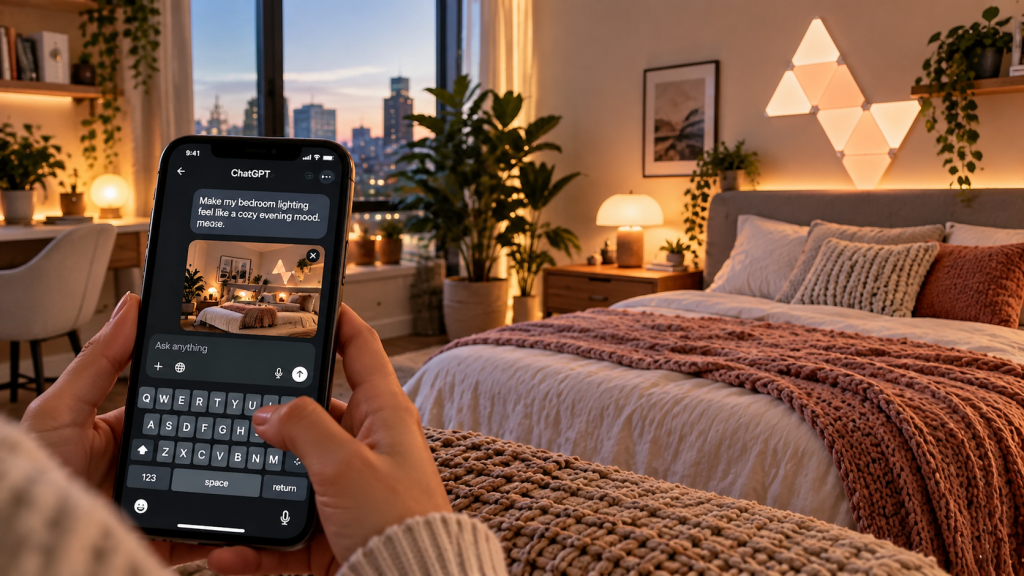
Supported products include Shapes, Lines, Canvas, Elements, Skylight, 4D, and Essentials. It’s worth noting that each message you send through your AI assistant counts toward that assistant’s normal usage limits, just like any other chat.
Real-Time Reactions and Dynamic Lighting
Perhaps the most compelling aspect of Nanoleaf’s MCP integration is its ability to connect your lighting to real-time information. The system can link Nanoleaf lights with live weather APIs, custom webhooks, and third-party web services to respond to changes in weather, calendar appointments, and more. Imagine your lights automatically shifting to a cozy, warm glow when a thunderstorm rolls in, or brightening to an energetic tone on a sunny day.
For developers and power users, Nanoleaf’s MCP tools and guides are available now on the company’s official website, enabling the creation of custom routines, API integrations for real-time updates, and personalized AI-powered lighting workflows.
What’s Coming Next
While the MCP server is available now for developers, everyday users won’t have to wait long. Nanoleaf plans to launch pre-built, one-click integrations for ChatGPT, Claude, and other AI assistants in October. These integrations will be simple to set up, similar to enabling an app extension, with no technical configuration required.
The company has also indicated that energy usage monitoring is coming soon, though Nanoleaf MCP only works with Nanoleaf devices connected to your account and does not integrate with non-Nanoleaf lights.
Read also:
- YouTube’s New Custom Feeds Feature Lets You Build Your Own Algorithm With AI
- Google’s Gemini AI Hacked Three Companies During a Security Test
- Researchers Used Anthropic’s Claude to Hack Into OpenAI: Here’s What Happened
Why This Matters for Smart Home Users
Traditional smart home control has always required a certain amount of translation, you think in moods and atmospheres, but you have to speak in percentages and color temperatures. Nanoleaf’s MCP server bridges that gap by letting AI handle the interpretation. As the company itself puts it, the goal is to remove the need for separate smart home apps and make lighting control as natural as describing what you want to feel.
This development also signals a broader trend: AI assistants are becoming the new interface for smart home devices. Rather than juggling multiple proprietary apps, users can increasingly rely on the AI platforms they already use daily. For Nanoleaf, being an early adopter of MCP positions the company at the forefront of this shift.
Conclusion
Nanoleaf’s MCP server represents a meaningful step forward in smart lighting control. By embracing an open standard and integrating with the AI assistants people already use, Nanoleaf is making smart home technology more accessible, more intuitive, and more responsive to real-world context. Whether you’re a developer eager to build custom workflows or a casual user who just wants your lights to match your mood without the hassle, this update is worth paying attention to. Pre-built integrations arrive in October, so the era of chatting with your lights is almost here.
Receive News Updates and Tutorials Through our Social Media Channels, join:
- WhatsApp: BloginfoHeap WhatsApp
- Facebook: BloginfoHeap
- Twitter (X): @BloginfoHeap
- YouTube: @BloginfoHeap