Understanding Variables and Assignments in Python
Python is known for its simplicity and readability, which makes it one of the best programming languages for beginners. One of the very first concepts every Python learner encounters is variables and assignments. While they may seem simple at first glance, variables are the backbone of almost every Python program, from small scripts to large applications.
In this guide, you’ll learn what variables are, how assignments work in Python, common rules and best practices, and how variables behave behind the scenes. By the end, you’ll have a strong foundation for writing clean, readable, and effective Python code.
Introduction to Variables in Python
In programming, a variable is used to store data so it can be reused and manipulated later. Think of a variable as a labeled container that holds a value. Instead of working with raw values repeatedly, you give them meaningful names.
Python makes working with variables easy because you don’t need to declare their type explicitly. The language automatically determines the type based on the value you assign.
Example:
age = 25
name = "Alex"
height = 1.75
Here:
agestores an integernamestores a stringheightstores a floating-point number
What Is Variable Assignment?
Assignment is the process of giving a value to a variable. In Python, assignment uses the equals sign (=).
Important note for beginners:
The
=sign does not mean “equals” like in mathematics.
It means “assign the value on the right to the variable on the left.”
Example:
x = 10
This means:
- Take the value
10 - Store it in the variable
x
How Python Handles Variables Internally
Unlike some languages, Python variables do not store the value directly. Instead:
- The variable name references an object in memory
- The object holds the actual data
Example:
a = 10
b = a
Both a and b point to the same value in memory. If a changes later, Python creates a new object instead of modifying the existing one.
This behavior is important for understanding how assignments and reassignments work.
Rules for Naming Variables in Python
Python has clear rules for variable names. Breaking these rules results in errors.
1. Variable names must start with a letter or underscore
Valid:
name = "John"
_age = 30
Invalid:
2name = "John" # Error
2. Variable names can contain letters, numbers, and underscores
Valid:
student_name = "Ada"
score2 = 90
Invalid:
student-name = "Ada" # Hyphens are not allowed
3. Variable names are case-sensitive
age = 20
Age = 30
These are two different variables.
4. Variable names cannot be Python keywords
You cannot use reserved words like:
if, else, for, while, class, def, True, False
Invalid:
class = "Math" # Error
Read also:
- Python Syntax Rules and Code Structure
- Introduction to Python Programming Concepts
- Introduction to Python for Scripting and Automation
Best Practices for Naming Variables
While Python allows flexibility, good variable naming improves readability and maintainability.
Use descriptive names
Bad:
x = 5000
Good:
monthly_salary = 5000
Use snake_case (PEP 8 recommendation)
Python’s official style guide (PEP 8) recommends lowercase names with underscores.
total_score = 85
user_email = "example@email.com"
Assigning Multiple Variables at Once
Python allows assigning multiple variables in a single line, which makes code concise and readable.
Multiple assignment
x, y, z = 1, 2, 3
Each variable gets its corresponding value.
Assigning the same value to multiple variables
a = b = c = 0
This assigns 0 to all three variables.
Variables and Data Types
Variables can hold different data types, depending on the assigned value.
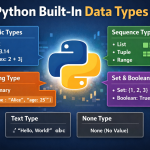
Common Python data types
count = 10           # int
price = 99.99        # float
name = "Python"      # str
is_active = True     # bool
Python automatically detects the type at runtime.
You can check a variable’s type using:
print(type(price))
Reassigning Variables in Python
One powerful feature of Python is that variables can be reassigned to new values at any time.
Example:
score = 60
score = 85
The variable score now holds 85. The old value is discarded.
Updating a variable using its previous value
balance = 1000
balance = balance + 500
Or using shorthand:
balance += 500
This increases balance to 1500.
Variable Assignment with User Input
In real-world applications, variables often store input provided by users.
Example:
name = input("Enter your name: ")
print("Welcome,", name)
Important note:
input() always returns a string
- You may need type conversion for numeric input
Example:
age = int(input("Enter your age: "))
Type Casting During Assignment
Sometimes, you need to convert a variable from one type to another.
Example:
age = "25"
age = int(age)
Other examples:
price = 99
price = float(price)

number = 10
number = str(number)
Type casting is especially useful when handling user input or external data.
Assignment Operators in Python
Python provides shorthand assignment operators that make code cleaner.
Examples:
x += 5    # x = x + 5
x -= 2    # x = x - 2
x *= 3    # x = x * 3
x /= 2    # x = x / 2
These operators improve readability and reduce repetition.
Common Beginner Mistakes with Variables
1. Using variables before assignment
print(score) # Error if score was never assigned
2. Confusing assignment (=) with comparison (==)
x = 10     # Assignment
x == 10    # Comparison
3. Overwriting important values unintentionally
total = 100
total = total - 100   # total is now 0
Always be mindful when reassigning variables.
Why Variables Matter in Python
Variables are essential because they allow you to:
- Store and reuse data
- Write dynamic programs
- Improve code readability
- Reduce repetition
- Build scalable applications
Without variables, programming would be repetitive, error-prone, and inefficient.
Real-Life Analogy for Variables
Think of variables like labeled containers in a store:
- The label is the variable name
- The content is the value
- You can replace the content anytime without changing the label
This analogy helps beginners visualize how assignments work.
Conclusion
Understanding variables and assignments in Python is a crucial step in becoming a confident programmer. Variables allow you to store data, assignments let you update and manipulate that data, and Python’s simplicity removes much of the complexity found in other languages.
By following proper naming conventions, understanding reassignment, and using variables thoughtfully, you’ll write cleaner, more readable, and more professional Python code.
As you continue learning Python, variables will appear in every topic, loops, functions, classes, data analysis, web development, automation, and beyond. Master them early, and the rest of your Python journey becomes much smoother.
Receive News Updates and Tutorials Through our Social Media Channels, join:
- WhatsApp: BloginfoHeap WhatsApp
- Facebook: BloginfoHeap
- Twitter (X): @BloginfoHeap
- YouTube: @BloginfoHeap