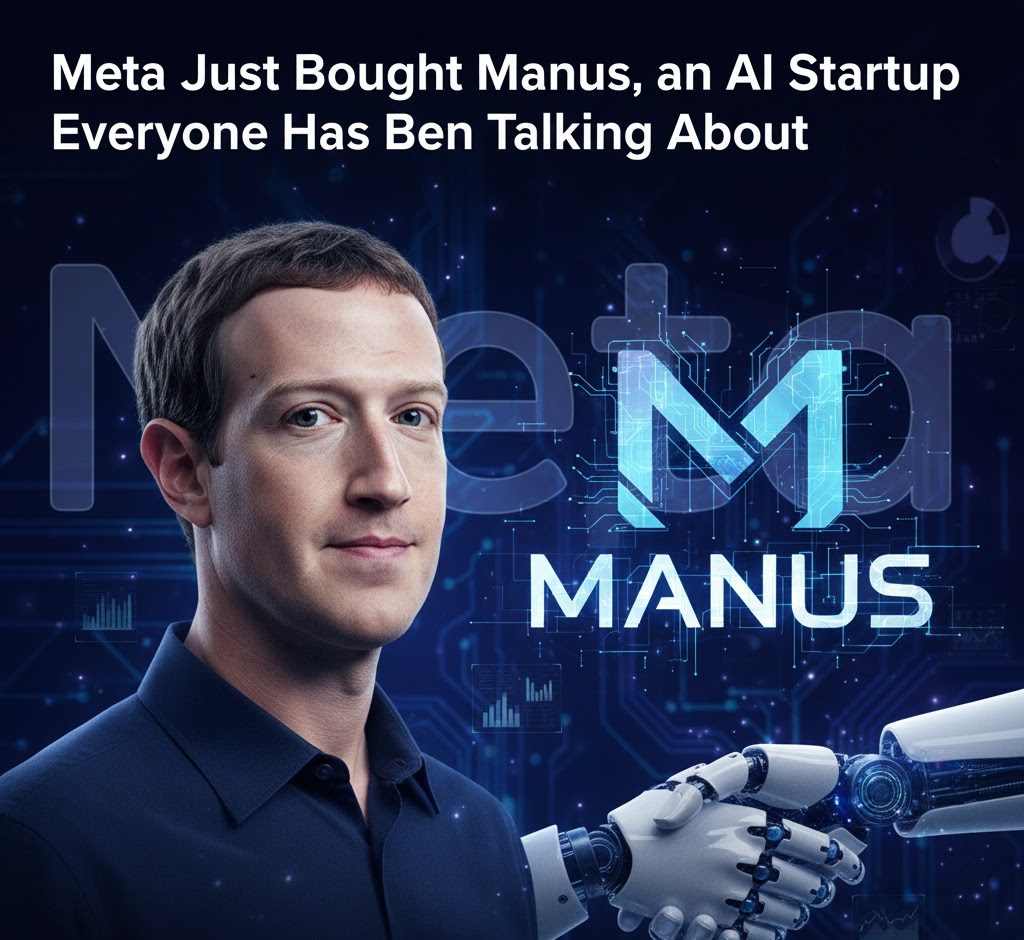
Meta Just Bought Manus, an AI Startup Everyone Has Been Talking About
Meta just made one of its boldest AI moves yet.
The tech giant has acquired Manus, a fast-rising AI startup that has dominated conversations across Silicon Valley after showcasing powerful autonomous AI agents capable of handling real-world tasks such as job screening, travel planning, and financial analysis. The acquisition signals Meta’s growing urgency to secure commercially viable AI products as competition with OpenAI, Google, and Anthropic intensifies.
In this article, we break down why Meta bought Manus, how much it paid, what Manus brings to the table, and what this means for the future of AI across Facebook, Instagram, and WhatsApp.
Meta Acquires Manus in a $2 Billion Deal
According to reports, Meta Platforms is acquiring Manus for approximately $2 billion, matching the valuation the startup was reportedly seeking for its next funding round. Negotiations began earlier this year, shortly after Manus announced rapid user growth and strong recurring revenue.
The acquisition comes at a critical moment for Meta CEO Mark Zuckerberg, who has placed artificial intelligence at the center of the company’s long-term strategy.
What Is Manus and Why Is Everyone Talking About It?
Manus is a Singapore-based AI startup that burst onto the scene last spring with a viral demo showcasing AI agents capable of:
- Screening job candidates
- Planning detailed vacations
- Analyzing stock portfolios
- Conducting deep, multi-step research
The company boldly claimed that its AI outperformed OpenAI’s Deep Research, immediately attracting attention from investors and technologists alike.
Within weeks of launch, venture capital firm Benchmark led a $75 million funding round, valuing Manus at $500 million. High-profile investors including Tencent, ZhenFund, and HSG (Sequoia China) also backed the company in earlier rounds.
Manus Is One of the Few AI Startups Actually Making Money
What sets Manus apart, and likely sealed Meta’s interest, is revenue.
By mid-December, Manus revealed that it had:
- Signed up millions of users
- Generated over $100 million in annual recurring revenue
- Monetized its AI agents through monthly and yearly subscriptions
For Meta, which faces growing scrutiny over its $60 billion AI infrastructure spending, Manus represents something rare in today’s AI landscape: a proven, revenue-generating AI product.
Related:
- Crypto hacks in 2025: Hackers stole over $2.7B in crypto in 2025, data shows
- Uniswap Token Burn Moves Closer to Reality as 99% Voters Favor ‘Fee Switch’ Proposal
- Crypto Firm Tether Says It Wants to Take Over Italian Football Club Juventus
How Meta Plans to Use Manus
Meta says it will allow Manus to operate independently, while gradually integrating its AI agents into:
These platforms already host Meta AI, but Manus brings advanced agent-based workflows that could dramatically expand what users can do inside Meta’s apps, from productivity tasks to commerce and research.
Political and Regulatory Concerns Around Manus
The acquisition is not without controversy.
Manus’ founders originally established its parent company, Butterfly Effect, in Beijing in 2022, before relocating operations to Singapore. This history has already drawn scrutiny in Washington.
U.S. Senator John Cornyn, a senior member of the Senate Intelligence Committee, previously criticized Benchmark’s investment in Manus, citing concerns about American capital flowing into companies with Chinese roots.
In response, Meta has stated clearly that:
- Manus will cut all ties to Chinese investors
- The company will cease operations in China
- There will be no continuing Chinese ownership post-acquisition
A Meta spokesperson confirmed this position to Nikkei Asia, aiming to preempt regulatory pushback.
Why the Manus Acquisition Matters for Meta
This deal highlights several strategic priorities for Meta:
- A push toward AI agents that deliver real economic value
- Faster monetization of AI beyond advertising
- Stronger positioning against OpenAI and Google
- Reduced investor anxiety over massive AI spending
For Zuckerberg, Manus is not just another AI bet, it’s a revenue-proven AI engine that could help justify Meta’s aggressive infrastructure investments.
What This Means for the AI Industry
Meta’s acquisition of Manus reinforces a growing trend in AI:
The market is shifting from flashy demos to products that generate real revenue.
As AI competition intensifies, startups that combine agentic intelligence, scale, and monetization are becoming prime acquisition targets, and Manus may be just the beginning.
Receive News Updates and Tutorials Through our Social Media Channels, join:
- WhatsApp: BloginfoHeap WhatsApp
- Facebook: BloginfoHeap
- Twitter (X): @BloginfoHeap
- YouTube: @BloginfoHeap