Uniswap Token Burn. The long-standing debate over Uniswap’s token economics is finally nearing a landmark resolution. The protocol’s major “UNIfication” governance proposal, which includes activating the long-awaited fee switch, has crossed quorum with overwhelming support. As of Monday, more than 69 million UNI tokens have voted in favor, representing over 99% voter approval and virtually no opposition.
Although voting remains open until December 25, the outcome appears decided: Uniswap is preparing to introduce its first true value-accrual mechanism for UNI holders.
What the ‘Fee Switch’ Means for Uniswap and UNI
At the center of the UNIfication proposal is a major shift in how Uniswap handles trading fees.
Currently, all trading fees across Uniswap’s decentralized exchange are routed directly to liquidity providers (LPs). UNI holders have governance rights but no direct way to benefit economically from the protocol’s enormous scale.
The new proposal introduces a fee switch, directing one-sixth of trading fees into a protocol-controlled pool. These accumulated fees will be used to:
- Burn UNI tokens, reducing supply
- Strengthen UNI’s price through deflation
- Link the token’s value directly to Uniswap’s daily trading volume
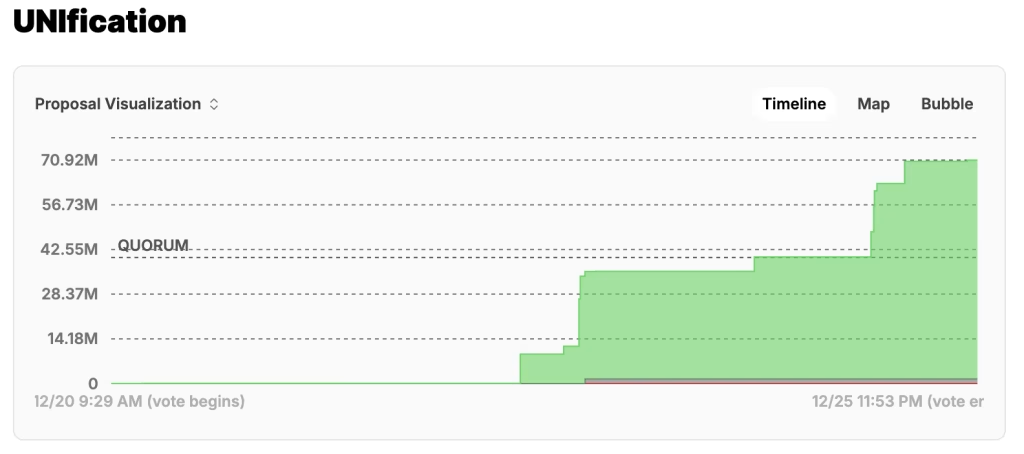
IMAGE CREDITS: COINDESK
Based on current trading volumes, this system could direct approximately $130 million per year into token burns, according to CoinDesk’s November analysis.
This transition effectively transforms UNI from a governance-only token into a value-accruing governance asset, bringing its economic model closer to other yield-sharing or cash-flow-linked tokens in DeFi. Uniswap token burn!
Related:
- Crypto Firm Tether Says It Wants to Take Over Italian Football Club Juventus
- MTN South Africa to Increase Subscription and Voice Charges Next Year
- OpenAI Fires Back at Google With GPT-5.2 After ‘Code Red’ Memo
A One-Time 100 Million UNI Burn
The proposal doesn’t stop at activating the fee switch.
It also includes a historic one-time burn of 100 million UNI from the treasury, roughly $940 million at current prices. This would significantly reduce circulating and future supply, amplifying the impact of future fee-driven burns.
Uniswap’s Scale Reinforces the Proposal’s Impact
Uniswap processes nearly $150 billion in monthly trading volume across more than 30 blockchains, according to DefiLlama. Supporters argue the protocol’s massive scale should be reflected in UNI’s economics, especially now that other decentralized exchanges have introduced fee-sharing models.
Activating the fee switch aligns Uniswap with its competitors and gives UNI meaningful utility beyond governance.
Restructuring Uniswap’s Internal Governance
The UNIfication proposal also restructures Uniswap’s internal foundations. It:
- Consolidates Uniswap Labs and the Uniswap Foundation
- Moves away from heavy grant-based governance
- Focuses on execution, distribution, growth, and competitiveness
The goal is to streamline operations and strengthen Uniswap’s position as DeFi’s largest decentralized exchange.
Receive News Updates and Tutorials Through our Social Media Channels, join:
- WhatsApp: BloginfoHeap WhatsApp
- Facebook: BloginfoHeap
- Twitter (X): @BloginfoHeap
- YouTube: @BloginfoHeap