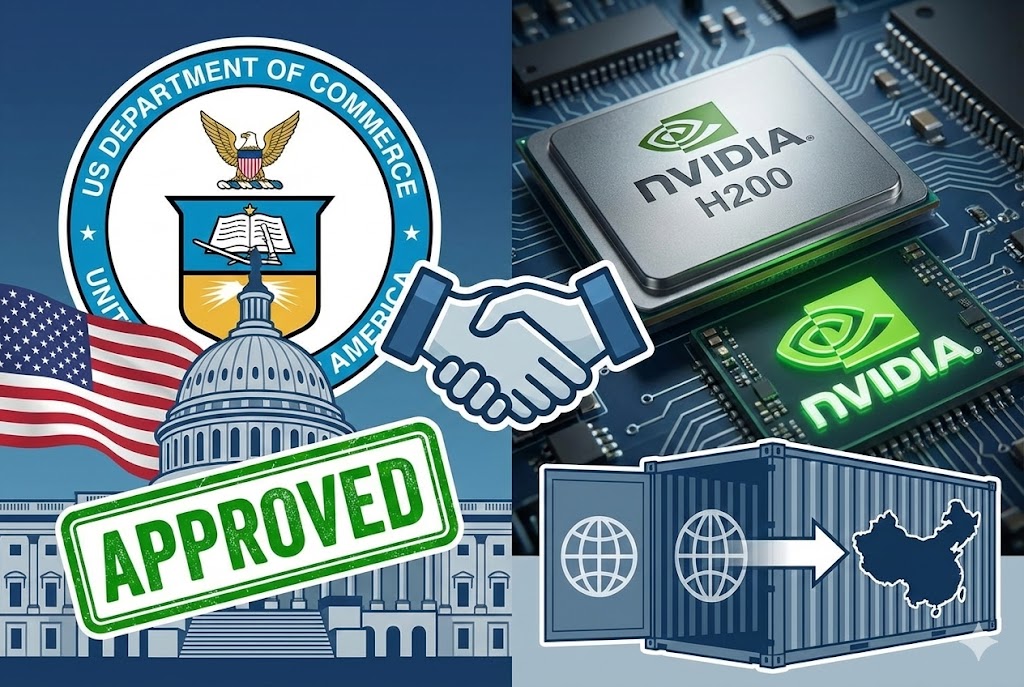
The Nvidia H200 chip exports to China have officially been approved by the U.S. Department of Commerce, marking a major shift in America’s AI chip export policy. After months of regulatory uncertainty, Nvidia will now be able to ship its high-performance H200 AI chips to licensed customers in China, with strict conditions attached.
This move arrives amid heated political debate, national security concerns, and ongoing competition between the U.S. and China in the global AI race.
U.S. Approves Nvidia H200 Exports – With Major Restrictions
Advanced Nvidia AI chips will return to China after the Department of Commerce granted approval for Nvidia H200 chip exports to China, as first reported by Semafor. However, only pre-approved commercial customers can purchase these chips, and the U.S. government will take a 25% revenue cut from each sale, according to CNBC.
Despite H200 being significantly more powerful than Nvidia’s China-specific H20 chip, only 18-month-old H200 units are eligible for export. This is intended to limit China’s access to cutting-edge AI hardware while still supporting U.S. manufacturers.
Nvidia welcomed the decision, saying:
“Offering H200 to approved commercial customers, vetted by the Department of Commerce, strikes a thoughtful balance that is great for America.”
A Policy Shift Driven by Politics and Economic Pressure
Just a week earlier, Commerce Secretary Howard Lutnick said the export decision rested entirely with President Donald Trump. The approval now puts the administration at odds with congressional leaders pushing for stricter controls.
Two bipartisan senators introduced the SAFE Chips Act, a bill that would ban exports of advanced AI chips to China for 30 months. Whether Congress will proceed with the bill remains uncertain given the administration’s new stance.
President Trump’s position on exporting AI chips to China has fluctuated significantly. Earlier this year, licensing requirements restricted all advanced chip exports. Over the summer, the administration signaled willingness to allow exports if the U.S. received a 15% revenue share, a stance that eventually evolved into the current 25% cut.
Related:
- CAC to Shut Down Unregistered PoS Operators From January 2026
- Coinbase Starts Onboarding Users Again in India, Plans for Fiat On-Ramp Next Year
- TechCabal’s Frank Eleanya Named Tech Journalist of the Year at AOT Lagos 7.0
China’s AI Chip Market Has Shifted
Due to U.S. trade restrictions throughout 2024 and 2025, China’s domestic companies began relying heavily on local chips produced by Alibaba and Huawei. In September, China’s Cyberspace Administration even banned local companies from buying Nvidia chips, closing the door on U.S. suppliers.
Now, the new approval may loosen some of that pressure, although only older H200 chips will enter the Chinese market.
President Trump announced on Monday that China’s president, Xi Jinping, “responded positively” to the export approval.
What This Means for the Global AI Hardware Market
The approval of Nvidia H200 chip exports to China is likely to:
- Boost Nvidia’s revenue after months of blocked sales
- Influence China’s AI computing capabilities, though at a limited scale
- Intensify political debates over national security and AI supremacy
- Shape future export policy negotiations between the U.S. and China
This decision also highlights how AI chips have become one of the most powerful tools in global trade negotiations.
Receive News Updates and Tutorials Through our Social Media Channels, join:
- WhatsApp: BloginfoHeap WhatsApp
- Facebook: BloginfoHeap
- Twitter (X): @BloginfoHeap
- YouTube: @BloginfoHeap