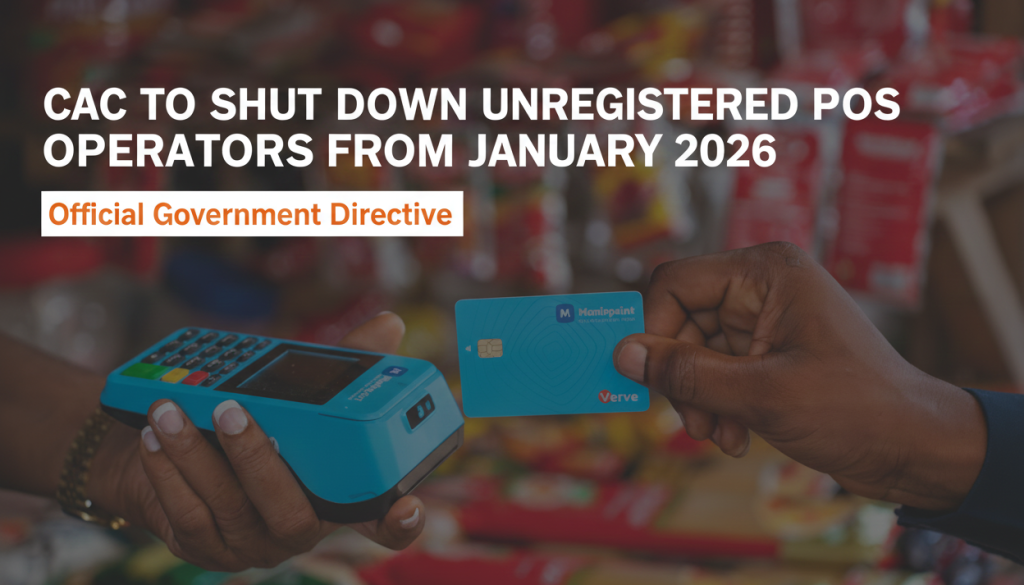
The CAC to shut down unregistered PoS operators directive is set to reshape Nigeria’s fast-growing agent banking sector. In a new public notice, the Corporate Affairs Commission (CAC) has ordered all Point-of-Sale operators to register their businesses before January 1, 2026, or face terminal seizure and enforcement actions. This marks one of the strongest regulatory crackdowns the sector has ever seen.
CAC’s New Directive: What It Means
In the notice released on December 6, 2025, the CAC said it has observed a “rising number of PoS operators running without registration,” calling the trend a violation of:
- CAMA 2020, and
- The Central Bank of Nigeria’s Agent Banking Guidelines
According to the Commission, this “reckless practice” is often enabled by some fintech companies, putting the financial system and consumer funds at risk.
Beginning January 1, 2026, any PoS operator without CAC registration:
- Will not be allowed to operate
- Regulators can seize their PoS terminal.
- May face security agency enforcement
This is the federal government’s most decisive move yet to clean up the fast-expanding industry.
Why the Crackdown Is Happening Now
Nigeria’s agent banking ecosystem has exploded in size in just a few years, with:
- Over 1.9 million PoS agents nationwide
- ₦10.51 trillion processed via PoS channels in Q1 2025, a 301.67% increase from the previous year
While PoS agents have become a critical part of Nigeria’s financial access infrastructure, regulators worry that:
- Operators lack proper business identity
- Fraud cases are increasing
- Oversight is weak
- Fintech companies are onboarding agents without adequate KYC
- Consumer protections are insufficient
In August 2025, the CBN already ordered that all PoS terminals operate within 10 metres of their registered address to curb terminal cloning and misuse.
The CAC’s directive is the next phase, shifting direct accountability to operators rather than only fintech providers.
Related:
- Coinbase Starts Onboarding Users Again in India, Plans for Fiat On-Ramp Next Year
- TechCabal’s Frank Eleanya Named Tech Journalist of the Year at AOT Lagos 7.0
- ChatGPT User Growth Slowdown, Report Finds – New Data Shows Gemini Closing In
Fintech Companies Now Under Pressure
The notice makes it clear: fintech companies enabling unregistered PoS operators will face consequences.
The CAC said such companies will:
- Be reported to the CBN
- Be placed on a regulatory watchlist
- Lose the ability to expand agent operations without compliance proof
This impacts companies such as Opay, Moniepoint, PalmPay, Nomba, and others that rely heavily on agent banking networks.
What PoS Agents Must Do Before January 2026
To operate legally from 2026 onward, every PoS operator must:
- Register their business with the CAC
- Obtain a Business Name (BN) or Company registration (LTD)
- Ensure their NIN, BVN, and business address match their registration
- Update their details with the fintech company powering their PoS terminal
Security agencies will enforce this nationwide, meaning operators in rural and remote areas must comply as well.
Industry Impact: What to Expect
The directive is to:
- Reduce fraud and impersonation
- Improve KYC and traceability
- Strengthen trust in PoS transactions
- Increase government visibility into the cash-based economy
- Raise operating costs for informal PoS agents
Some analysts predict that fees may temporarily rise as operators absorb registration costs, but long-term benefits will include a safer and more stable payment ecosystem.
The CAC to shut down unregistered PoS operators initiative marks a major regulatory turning point for Nigeria’s digital financial sector. As the government tightens compliance, both PoS agents and fintech companies must prepare for stricter oversight. With millions relying on PoS services daily, achieving a secure and transparent system has never been more critical.
Receive News Updates and Tutorials Through our Social Media Channels, join:
- WhatsApp: BloginfoHeap WhatsApp
- Facebook: BloginfoHeap
- Twitter (X): @BloginfoHeap
- YouTube: @BloginfoHeap